
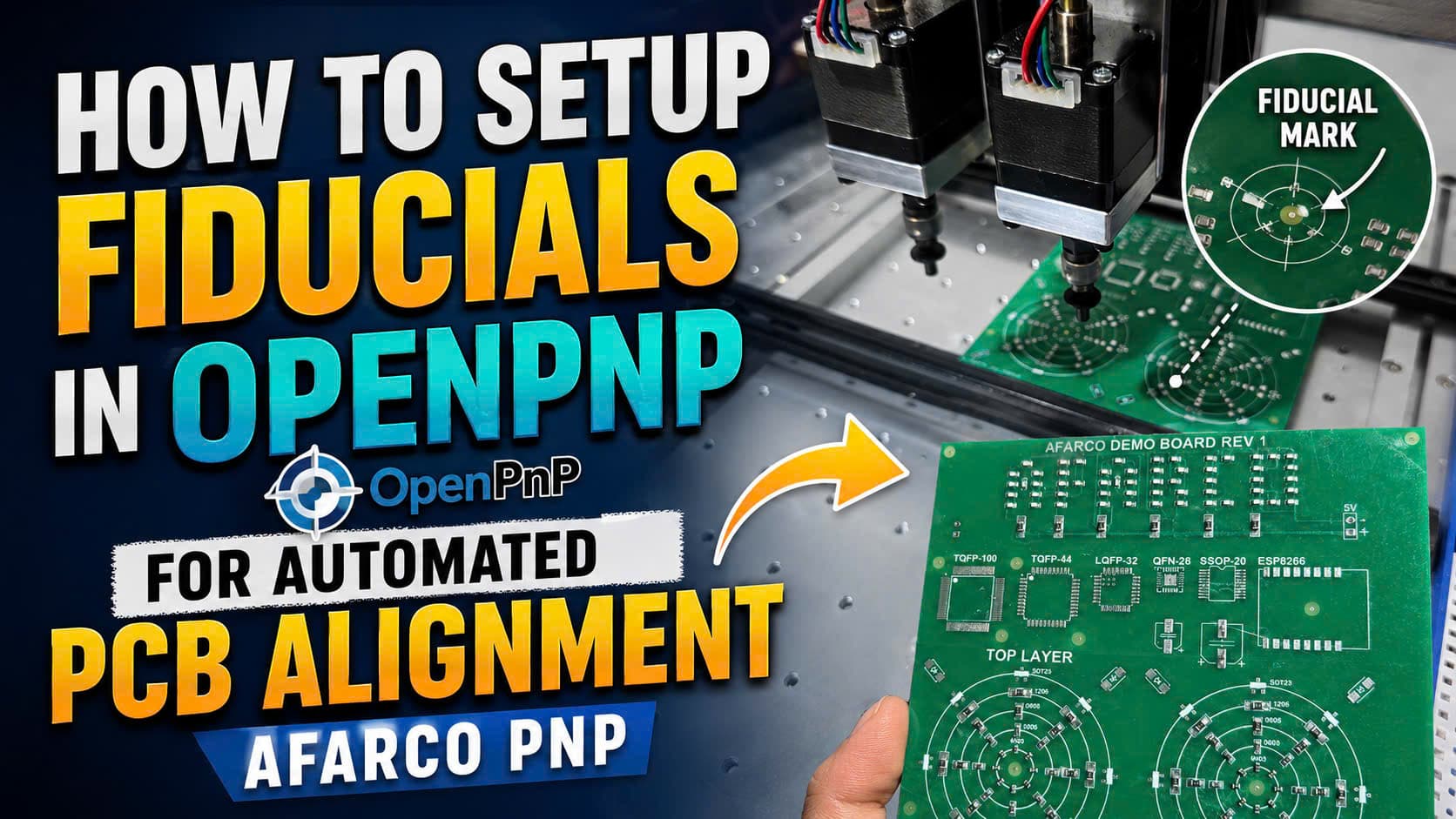
Meta Description: Discover how OpenPnP's fiducial recognition feature automates PCB alignment, guarantees high-precision component placement, and streamlines your SMT assembly process.
Mastering Precision: Why OpenPnP’s Fiducial Recognition is a Game-Changer for SMT Assembly
When it comes to automated Surface Mount Technology (SMT) assembly, precision is everything. Placing microscopic components like 0402 resistors or ultra-fine pitch ICs requires a system that knows exactly where your circuit board is at all times. This is where OpenPnP’s Fiducial Recognition steps in.
If you are running an open-source pick and place machine, understanding and utilizing this feature is the key to transitioning from a hobbyist setup to professional-grade manufacturing. Here is why OpenPnP's fiducial system is incredibly brilliant and highly convenient for modern PCB assembly.
What Are Fiducials?
Fiducials (or fiducial markers) are specific, dedicated copper pads left exposed on a printed circuit board (PCB) during manufacturing. They don't carry any electrical signals. Instead, they act as visual reference points for the Pick and Place (PnP) machine’s downward-facing camera. By locating these markers, the machine can calculate the exact X, Y, and rotational offset of the board resting on the work area.
The Brilliance of OpenPnP’s Fiducial System
OpenPnP handles fiducials with a highly advanced, automated computer vision pipeline. Here is what makes it stand out:
-
Absolute Automated Alignment
You don’t need to perfectly align your PCB on the machine bed every single time. You can simply place the board within the camera's general field of view. Once you hit "Run," OpenPnP drives the camera to the expected fiducial locations, uses its vision pipeline to detect the exact center of the markers, and instantly mathematically rotates and translates the entire placement job to match the physical board. It is seamless and saves massive amounts of setup time. -
Robust Computer Vision via OpenCV
The underlying vision engine relies on OpenCV, allowing users to customize the detection pipeline. Whether your fiducials are perfectly shiny HASL, matte ENIG (gold), or covered in slight flux residue, you can tweak the thresholding, blur, and Hough Circle transforms in OpenPnP to ensure the camera finds the mark every single time under various lighting conditions. -
Support for Panelized Boards
For high-volume production, OpenPnP’s fiducial system scales beautifully. It supports both global fiducials (to align the entire panel) and local fiducials (to align individual sub-boards within the panel). If one small board on a large panel was printed with a slight skew, local fiducials ensure that specific section gets corrected independently, practically eliminating placement errors. -
Self-Healing and Error Handling
If OpenPnP fails to find a fiducial automatically, it doesn't just crash or ruin your board. It pauses and prompts the operator to manually click the center of the fiducial via the UI. This highly convenient fallback mechanism ensures your production run continues smoothly without wasting expensive components.
Hardware Matters: Maximizing Fiducial Accuracy
While OpenPnP’s software is exceptionally smart, software mathematically correcting offsets is only half the equation. To truly benefit from fiducial recognition, your machine's physical hardware must be capable of executing those micro-adjustments flawlessly.
A flimsy 3D-printed frame will introduce vibrations and backlash, negating the precise calculations made by the camera. To achieve the sub-millimeter accuracy required for modern electronics, the vision system must be paired with a rigid, high-precision mechanical foundation.
Systems built entirely from CNC-machined 6061 aluminum alloy with high-quality linear rails—such as the AFARCO MINI PNP series—provide the ultimate stability. When OpenPnP calculates a 0.05mm offset from a fiducial reading, a solid aluminum gantry ensures the placement nozzle hits that exact coordinate with zero flex or resonance. Gray or black anodized aluminum parts also help reduce unwanted glare for the downward-looking camera, indirectly assisting the vision pipeline.
Conclusion
OpenPnP’s fiducial recognition isn't just a "nice-to-have" feature; it is the core mechanic that allows desktop and mid-range SMT machines to compete with heavy industrial equipment. By taking the human error out of board alignment and relying on automated vision pipelines, it provides an incredibly convenient, repeatable, and stress-free assembly experience.
Pair this intelligent software with robust, CNC-machined hardware, and you have a production powerhouse ready to tackle any PCB design.
Product: https://afarco.com/products/afarco-pnp-v3-2
🌐 Explore our products: https://www.afarco.com
📩 Business Inquiries: contact.afarco@gmail.com
📱 WhatsApp/Contact: +84 989 941 355
📍 Designed & Manufactured by AFARCO
shareShare this article